Thursday, 27 June 2013

Mixing Magic Part 1

Mixing desks or consoles are often thought of as the heart of the sound system.
They take all the signals from all the various inputs and route them to all the various outputs.
They are usually the critical point of failure in a sound system in that if the mixer dies, your show is usually over.

A mixing desk can cost anywhere from $100 up to $500,000 for large concert consoles, but how much do you need to spend and what features are the most important.
 Is it worth considering a digital console or should you stick to analog?

The first thing to do is to consider the number of channels you need. To do this, work out how many channels you will use on the largest show you think you will be doing then add 20% to this number.

Next figure out how many outputs or buses you will need. There are several different types of output buses. A bus is basically somewhere you can send audio and control how much of each signal you send there. So for example a monitor speaker on stage is connected to an Aux (Auxiliary) bus and you can adjust how much of each instrument is in that individual monitor.

  • Aux 
    • Many mixing desks alow you to switch an auxiliary bus between Pre-Fade and Post-Fade mode, while others have a certain number of fixed Pre and Post busses.
    • Pre-Fade Auxiliaries
      • Pre-Fade Auxiliaries are used for driving monitor speakers on stage. The signal is sent to the bus before the main fader, so if someone turns down the fader for the guitar in the PA, the Guitarist can still here it in their monitor unaffected.
      • Work out how many monitor speakers you will need with individual control and this is the number of Pre-Fade Aux channels you need on your mixing desk.
    • Post-Fade Auxiliaries 
      • These are used to send to effects processors because when you turn down the fader on a channel, it reduces the amount of signal going to the effects processor by the same relative amount.
  • Groups
    • Groups are used to group together similar instruments and control their volume with one fader. For example you might put all of the drum channels onto one group, then you can turn down the drums with one fader instead of a whole lot. Groups also allow you to send all of the channels that are in that group out to somewhere else, perhaps a compressor or another effects processor. Groups are not necessary, but they can be handy on larger mixers.
  • Master Bus
    • This can comprise of one or more channels such as "Left", "Right", "Center" or on surround consoles there may be additional channels on the Master Bus for surround speakers.
  • Matrices
    • Matrices take the outputs from a Master Bus, Group or Aux and allow you to mix them together to form a new output with additional control. These might get used if you need to send a feed to a video recorder, another room or a broadcaster.
Once you have figured out how many buses you need, add 20% to the Aux count and you can then start narrowing your search down for a new mixer.

Thursday, 20 June 2013

Getting Amped Part 3


There are a few more things to consider when buying an amp, so below are some of the other numbers you see on amp specifications that are very important. Hopefully I'll be able to explain them in the plainest of English possible.

THD or Total Harmonic Distortion. This is usually expressed as a percentage and reflects how much 'crap' you will hear. Total Harmonic Distortion is a bad thing in a power amplifier. Its a quality that that you might want in your guitar amp but not in PA amplifier. Whenever you amplify a signal, a percentage of the signal is converted into distortion. This makes things sound louder and more painful than they really are. When this occurs, people put their fingers in their ears. A lot of cheap amps don't even publish their THD figure so be careful. Some of the poorer quality amps you see in music shops have THD's in excess of 1%. At this level, the distortion is highly audible. A good THD rating is closer to 0.05% or less.

Noise Floor - Basically, this is how much 'hiss' is in your amp. Its important for amplifiers that will be driving high frequency speakers like horns, if you are a thrash metal band, probably less important, but if you have quiet periods then hiss is extremely distracting. A noise floor is measured in terms of the dynamic range of the signal and might be called either Noise Floor or Signal to Noise Ratio (SNR). Basically it measures how quietly you can turn down the amp before the hiss becomes louder than the signal you are trying to amplify. Try it on your home stereo, play a CD then turn it down slowly until you start to hear a hiss come through the speakers. At the point the hiss is louder than the music, you have reached the Noise Floor. A low number is good, basically we want to be able to keep turning it down and not hearing any hiss. Anything below -100dB (minus 100) is good (so -105dB is better than -100dB). Avoid anything in the 90's.

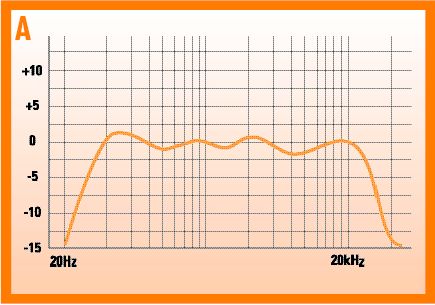
Frequency Response - This describes how accurately the amplifier reproduces all of the various frequencies you send it. It is usually listed as a 'plus or minus' rating. A low number is good. If your amp states it has a frequency response of 20Hz to 20Khz +-3dB. That means that any one frequency may be 3dB louder or quieter than any other frequency. Imagine if 440Hz (middle A on the piano) was 3dB louder than middle C (261Hz) and 1000 Hz was -3dB quieter than middle C. This would mean there was 6dB difference in loudness between 440Hz and 1000Hz. This sounds terrible. A good amp should have a frequency response of +-1dB or preferably much less.

Damping Factor - Describes how well an amplifier will be able to actually control the speakers connected to it. This is particularly important for subs. Think about what happens when a speaker moves, a current is put into the the speaker coil and the speaker cone jumps out or in accordingly. Now when that current is removed, the speaker moves back to its rest position, as it moves back through the coil, this generates electricity in the coil which feeds back into the amp. Moving a speaker in and out manually actually generates electricity (just the way a microphone generates a signal, only on a much bigger scale). This signal is actually going to fight what the amp is trying to do to the speaker and the damping factor tells you how likely it is the amp will win the war. An amp with a poor damping factor will cause a fluttery wet bass sound. An amp with a high damping factor will have tight and smooth bass. A damping factor of 400 or more is outstanding and highly desirable. Anything around 250 to 300 is pretty good. Below 200 and you are into the poor category.

Slew Rate - determines how quickly an amp can go from one extreme to the other. The faster the slew rate, the tighter and punchier the sound will be. If an amp is slow then the sound will be 'wet' and loose sounding, especially when it comes to bass and very high frequencies. Most people completely ignore this number when they buy an amp. Check out the various makes and models, generally the more expensive amps will have a fast slew rate (reflected as a lower number). Try asking your local music dealer what the Slew Rate of the amp they are trying to sell you is and you will more than likely get an odd look. This is where prior research is critical in making a good amp buying decision.

Bridged Mode - This is beyond the scope of this article and I may tackle it some other time. Generally most musicians should avoid bridge mode unless they really know what they are doing.

Now go forth and amplify.

Thursday, 13 June 2013

Getting Amped Part 2


Power Play

The amount of power your amplifier can deliver depends on the load. The higher the load, the more power will be delivered and often doubling the load roughly doubles the power that the amp can deliver.
Think of it like a car again, it would be really hard to overheat a car engine by sitting in the driveway and just revving it at full revs. However it is much easier to overheat it when you are towing a big load in a trailer. Everyone is no doubt familiar with the hot stink of a car that has just climbed a hill. Climbing a hill is harder than sitting in the driveway revving. Even though the car might be capable of delivering 200 horsepower, you can't actually use all that power until you put a load on the car. Amplifiers are exactly the same.

When purchasing an amp, the first thing you have to work out is what your load is. Generally manufacturers promote the power of their amps at its 4 Ohm or 2 Ohm load. So if an amp can deliver 200 Watts at 8 Ohms, 400 Watts at 4 Ohms and 600 Watts at 2 Ohms they will probably call it a 600 watt amp, sometimes even a 1200 Watt amp, if it has two channels.  This is where people trip up and buy the wrong amp.
If you have two, 8 Ohm Speakers rated at 500 Watts each and you bought this amp, then you are really only powering your speakers with 200 Watts not 1200 Watts  as you might think.
Thats a lot of extra power your speakers could handle that you aren't giving them.

In reality, you probably need a 2000 Watt amp to give your speakers the full 500 Watts that they could handle.

When powering speakers, it pays to OVERPOWER them not under power them.
This is because speakers can handle brief spikes over their rated power but if you under power them, there is a risk you might drive the amp too hard and cause square wave distortion that can actually destroy your speakers. That's right, you read that correctly, you have a greater chance of blowing up your speakers by using too small a power amp compared to using too large a power amp.

The other reason overpowering is good is to do with headroom, if you have a big grunty amp that is idling then its going to sound a lot better than a tiny little amp thrashed to within an inch of its life. Think of it like a Mini Cooper towing a trailer, sure you can do it, but you will probably damage the mini. A V8 Range Rover is going to do a much better job of towing the trailer than a Mini. Towing a small trailer with a Range Rover does not do any damage to the  trailer and it gives you a nice smooth ride. Whenever possible I overpower speakers by a factor of two, so if you have 500 Watt speakers, I power them with 1000 Watts.

I mentioned earlier that amps store power, this is because the frequency that power comes out of the wall socket is only 50Hz (50 cycles per second), that is the equivalent of a very low bass note. Now if we are trying to produce a higher note that is 500 Hz (a medium note on a piano) and we need to make it loud in a hurry, then the mains power from the wall is moving too slowly to deliver the the power needed at the instant we need it. This would sound like a 'sag' where the initial note was quiet then gradually got louder as the power supply caught up. In some poor quality amps you can actually hear this with a good loud bass note. You hit a note really loud and all of a sudden and it sounds like it has been sucked empty, then gradually gets louder, then gets quieter again as the amp 'runs out of guts'.

To get around this issue, amps need to store a lot of power. They take a constant stream of slowly oscillating power coming from the wall socket and store it up so that a large amount of power can be delivered very quickly. Think of it like a Water Blaster, the low pressure from the water main fills a temporary tank. Then the water blaster sucks this out and makes it high pressure. If the tank on your Water Blaster is too small then it constantly runs dry and you have to stop water blasting and wait for it to fill up again. If the power storage capacity of your amplifier is too small, then it will constantly run out of enough power. Amplifiers are just the electronic equivalent of a high pressure Water Blaster.

Different classes of amp have different ways of converting and storing power. Old amps use large coils of copper and giant capacitors which is why they weigh so much. Modern amps convert the power into a very high frequency using a Switch Mode power supply very similar to the one inside your computer (only much bigger) allowing them to be lighter and more efficient.

Thursday, 6 June 2013

Getting Amped Part 1

Amplifier technology has come a long way in the last 15 years.
When I first started in sound, amplifiers weighed more than me and delivered only a few hundred watts of power with dubious fidelity.

Those who have been around long enough will remember amps like the ZPE 500 which almost required a forklift to lift and delivered an (at the time) awesome 250 watts a channel.

These days there are multiple different types of amplifier design (called classes), the class of the amp is not an indication of its quality, it simply indicates what sort of design the amplifier circuit uses.

Amplifiers do three jobs, they convert the relatively high voltage / low current power supply that comes out of your wall socket into a format that speakers like (low voltage / high current), they store power so that it can be quickly released when needed and they take a low level signal from your mixing desk and turn it into a high power signal capable of driving speakers.

There is much more to an amp than Watts, in fact the power rating of an amp can be very deceptive.
If an amp does not have very much storage capacity then it might be able to deliver a large amount of power in a short burst before it 'runs out of guts'. When an amp 'runs out of guts' it is not a pleasant sound.

Things can get very technical here, so I'll try and keep it as simple as possible. If you learn nothing else from this post, it should be that the power rating is not the most important thing about an amplifier and that you generally get what you pay for. Generally, a cheap amp will never be a good amp, no matter how many bazzilion watts it claims to deliver.

Getting Loaded

The first thing to consider is the load the amp will be driving. Think of it like a car towing a trailer, the more stuff you put in the trailer, the harder the car has to work to tow it. Load is measured in Ohms (Resistance) but unlike the weight of a trailer, the lower the Ohms of the load, the harder the amp has to work to 'pull it'.
  • 16 Ohms is a light load.
  • 8 Ohms is an average load
  • 4 Ohms is pretty heavy going but should be within the reach of most modern amps.
  • 2 Ohms is where we separate the men from the boys
  • 1 Ohm will kill most amps and put them into protect mode
The more speakers you put on an amp channel (when wired in parallel), the higher the load (the lower the Ohms).
Most common individual speakers are 8 Ohms and by adding another one in you double the load to 4 Ohms. 2 Ohms is generally 3 x 8 Ohm speakers or possibly 2 x 4 Ohm speakers. It gets a bit messy when you start mixing speakers in series so I won't go into that here as that is a separate topic.

Got it?

Thursday, 30 May 2013

Microphone Madness Part 2


Within the two types of microphone we looked at last week, each mic will have a property that we call "Polar Pattern" or "Pickup Response". This property determines where a microphone picks up sound relative to the direction it is pointed. There is a wide range of pickup patterns and the pattern is exceedingly useful in controlling and enhancing sound. Using the right mic with the right pickup pattern for the job will have a massive impact on the quality of sound.

The various pickup patterns available include:
  • Omnidirectional
    • Picks up sound equally from all directions. Basically it doesn't matter where you point the mic it will pick up sound from anywhere in the room. This can be good and bad and generally you don't want omnidirectional mics in a live environment. If you point an omnidirectional microphone at a guitar cabinet but the guitar cabinet is sitting right next to a giant bass cabinet, then you will get a lot of the bass sound in the guitar mic. This makes it hard to control the sound if the bass is too loud.
  • Bi-Directional
    • These pickup sound from the front and back but not from the sides, again these are not much use in live sound because if you put a Bi-Directional microphone on a vocalist, but the other side of the microphone is pointing at a stage monitor then you are going to pickup all the noise from the stage monitor which will cause feedback.
  • Sub-Cardiod
    • These mics pickup sound from the front and a little bit of sound from the back, we usually avoid these in live sound as well unless we are mic'ing the inside of a drum or something where we want to pickup the sound of the drum shell. Sub-Cardioid mics are also fairly prone to feedback.
  • Cardiod
    • These are the most common and useful mics in live sound. They pickup sound at whatever you point them at and reject  most of the sound coming in from the other direction. This is most useful when you have other noise sources on stage that you don't want to pick up, for example stage monitors.
  • Hyper and Super-Cardiod
    • These mics are really directional but do pickup a little from the back as well. You will find that moving slightly off the front of the mic results in a dramatic reduction in sound level. These should only be used on vocalists who really know their stuff or for very specialist applications by a sound engineer.
  • Shotgun Mic
    • These mics only pickup sound that is coming directly from the direction you point the mic, any sound from the sides is actively rejected. They are most often used in theatre, television or stage shows.
Dynamic Microphones degrade over time, especially when they are used for vocals where dirt and grime from saliva builds up on the diaphragm making it heavier and slower to respond. There is no easy way of cleaning a mic diaphragm so the best you can do is regularly clean the grill and windsock to limit the damage.

If you are vocalist, its is often a good idea to buy your own mic and don't share it. This will also reduce the chances of picking up some nasty bug from a shared microphone. If you are going to buy your own mic, talk to a sound engineer about which mic to choose to suit your voice. There is no point skimping if you are going to buy your own. If in doubt, buy a Shure Beta 58 as that is still the industry standard fallback mic for vocals.

Be wary about wireless microphones. So many times I see artists with wireless microphones that sit in the mic stand all night and don't move. Ask yourself if you really need the mobility and portability of a wireless mic? No matter how much you spend, a wireless mic will always sound worse than the equivalent wired version of the same mic. Always use wireless as a last resort when there is no other option and a portable solution is required. Unless you are leaping across bar tables or stage diving into a mosh pit while singing at the same time, you will always sound better with a wired mic.

Be wary of 'cheap' microphones. You get what you pay for and cheap microphones often have un-desirable or unpredictable pickup patterns that will cause you a world of pain when it comes to feedback. Stick to the reputable brands and don't go for the bottom of the range, usually the mid range offerings from all the manufacturers offer the best value for money and quality for your dollar.

Good brands are Audio Technica (avoid their cheap stuff), Shure (avoid the PG and SLX series), AKG (only their expensive stuff is good, avoid the cheap stuff), Sennheiser, Beyerdynamic, Crown and EV.

If you have some extra dollars to spend, check out the offerings from Heil, Blue, Rode and Neuman.

Brands to avoid are Behringer, Line 6, and  Peavey.
I am personally on the fence about Audix, but some people rave about them.

Picking the right microphone for the job will make a huge difference to your sound quality. It also saves you having to spend a lot of time adjusting the sound on a mixing desk.

Thursday, 23 May 2013

Microphone Madness Part 1

Last week we discussed the importance of cables in a sound system and that they are in fact the most important component of the system.

Second on the list of importance is the microphones you use.

There are two types of microphone commonly used in modern sound systems. Dynamic Microphones and Condensor microphones (There are other types as well but we won't go into them here). Within these two categories microphones have a property that we call "pattern".

Dynamic Microphones are basically a small speaker, a diaphragm inside the mic vibrates with the sound in the air generating a small electrical voltage. Its the exact opposite of the way a speaker works and in actual fact you can hook up a speaker to a mixing desk input and use it as a dynamic microphone (albeit a fairly low quality one).
Dynamic microphones are used for vocals and on many instruments. What makes them particularly useful is the way they respond to bass. The closer the signal source to the microphone the more bass will be in the signal. This is called "Proximity Effect" and is most useful on vocal microphones. You may often see artists pull away from the mic during a high note to emphasise the note and then come in close when singing low to emphasise the low frequencies (think Barry White). The most famous dynamic microphone is the Shure SM58 and SM57 (basically they are both the same mic) which were the staple microphone for vocals and guitars for 30+ years. Today there are a wide range of dynamic mic's available. Dynamic microphones are generally not great at picking up very high frequencies, due to the fact that the large heavy diaphragm needs to be moved by the sound source and high frequencies are low in energy.

Condenser microphones work very differently to Dynamic Mics. A Condenser mic has two tiny plates inside it with a voltage between them. When the top plate is vibrated by the sound source, the capacitance between the two plates changes causing a signal to be generated. Condenser mics therefore need a power source to work and this is the most obvious external difference that you can use to identify a Condenser mic. The power source either comes in the form of an internal battery or power is delivered from the mixing desk down the microphone cable in the form of "Phantom Power".

Because the top plate on a Condenser mic is much smaller and lighter than a diaphragm of a dynamic mic, the Condenser mic is very good at picking up high frequencies. Condenser mics are also far less sensitive to the Proximity Effect so pick up bass signals evenly no matter how close or far away from the sound source the mic is. This is why you most often find Condenser microphones in recording studios, however they also have many applications on live stages.

Below is a summary of where you should use each type of microphone in a live situation.

Dynamic
  • Kick Drum
  • Snare
  • Tom Drums
  • Bass Guitar
  • Guitar
  • Vocals
  • Brass
Condenser
  • Hi Hats
  • Drum Overheads (Cymbals)
  • Choirs
  • Vocals (think Opera)
  • Brass
  • Kick Drum (when you want more high frequencies)

Thursday, 16 May 2013

Cable Conundrums Part 2

Last week we looked at the important of investing in good cables for your system and what happens if you don't. This week we look at how to maintain that investment in cable to ensure you always get the best out of your system.

Once you have your cables sorted, invest in a good case. A brown suitcase is not a suitable case. Get a road case with wheels and it will force you to treat your cables with the respect they deserve instead of chucking them in the van in a space wherever they will squeeze.

The key to keeping you cables in good nick is learning how to coil them correctly. If you wrap them around your elbow like the un-educated fellow in this picture then your cables will start to look like your mothers vacuum cleaner cord. Notice all the kinks in his cable. When you wrap a cable around your elbow, you actually twist the internal braiding causing irreparable damage. Your cable will never be the same again and if this behavior continues, it will eventually lose its shielding properties and the sound quality will dramatically fall. You may start to notice more noise in your system and eventually the cable will actually fail or even worse, become unreliable.
See the video below on how to avoid this and coil your cables properly.


A good cable tester is also a great investment, check your cables regularly with both a visual and electrical inspection. Also, if you do find a cable with a fault, coil it up and tie a knot in it so that you know it is faulty. Don't put it back in your cable case, keep it separate until you can get it fixed.

If you find you have collected a few cables from gigs and are not sure on their heritage then don't trust them. Don't just throw them into your cable crate and adopt them. Treat them as tainted goods and try and return them to their owner. Generally if cables get left behind and are unclaimed, it is for a reason and you don't want the hassle of adopting someone else's outcasts.